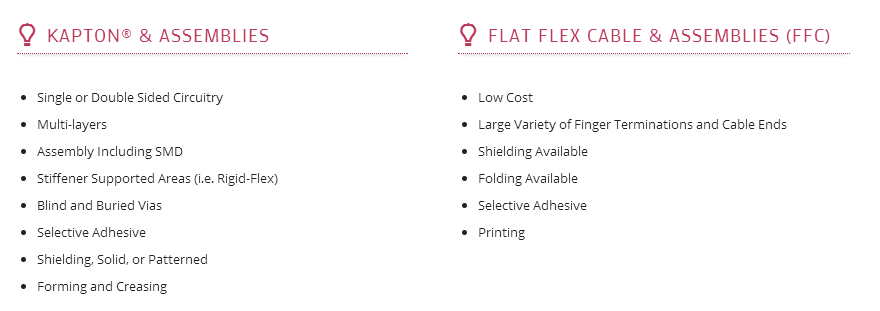
Kapton OSP Camera Single Layer FPC Board
- Product Details
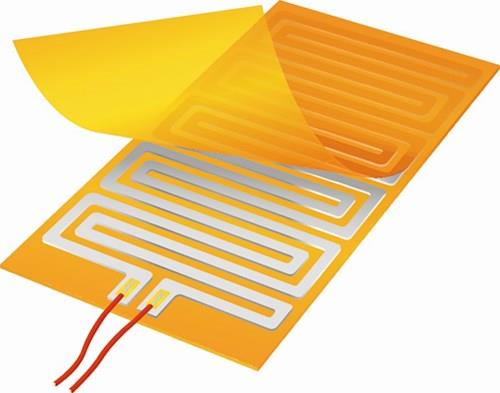
Kapton is a polyimide film developed by DuPont in the late 1960s that remains stable across a wide range of temperatures, from −269 to +400 °C. Kapton is used in, among other things, flexible printed circuits (flexible electronics) and thermal blankets used on spacecraft, satellites, and various space instruments.
The chemical name for Kapton K and HN is poly (4,4'-oxydiphenylene-pyromellitimide). It is produced from the condensation of pyromellitic dianhydride and 4,4'-oxydiphenylamine. Kapton synthesis is an example of the use of a dianhydride in step polymerization. The intermediate polymer, known as a"poly(amic acid)", is soluble because of strong hydrogen bonds to the polar solvents usually employed in the reaction. The ring closure is carried out at high temperatures (200–300 °C (392–572 °F; 473–573 K)).
Due to its large range of temperature stability, and its electrical isolation ability, Kapton tape is usually used in electronic manufacturing as an insulation and protection layer on electrostatic sensitive and fragile components. As it can sustain the temperature needed for a reflow soldering operation, its protection is available throughout the whole production process, and Kapton is often still present in the final consumer product.
Kapton® FPC offers superior dimensional stability and adhesion, and is specifically designed for flex circuit manufacturers. In applications where superior adhesion and low shrinkage are important, Kapton® FPC is the polyimide film of choice.
Applications include:
Flexible printed circuits
Automotive
Computers
Consumer products
Telecommunications equipment
Industrial instrumentation and controls
Military applications
Aerospace
Electronic parts
PCB stencils
Screen printing
Insulation tubing
TYPICAL PROPERTIES OF Kapton® FPC
PROPERTY | 1 MIL | 2 MIL | 3 MIL | 5 MIL |
Dielectric Strength, V/mil | 7.700 | 6,100 | 5,200 | 3,900 |
Coefficient of Thermal Expansion, ppm/°C | 20 | 20 | 20 | 20 |
Adhesion, pli | 10 | 10 | 10 | 10 |
Dimensional Stability, % | .03 | .03 | .03 | .03 |