


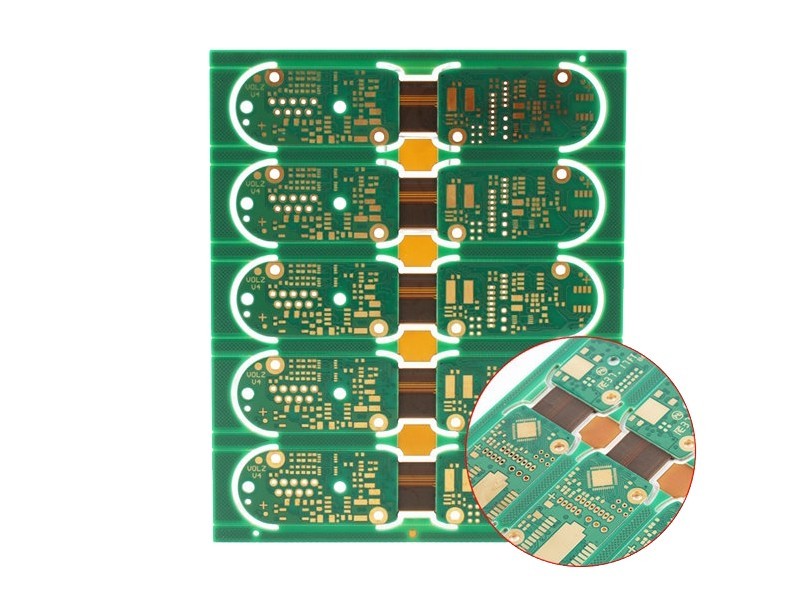
High difficult rigid flex pcb board pcb printing
Place of Origin:Guangdong, China
Brand Name:PCB
Supplier Type:Factory
Product name:Rigid-flex Pcb Board
Copper Thickness:0.5oz-6oz
Board Thickness:0.2mm - 7mm
Service:One-stop PCBA Service
Certificate:ROHS,ISO9001,ISO14001,5S,6Q
Solder mask:Green. Red. Blue. White. Black.Yellow.Grew
Testing Service:AOI,FPT,ICT,X-RAY,Flying probe test
Material:FR4,HI-TG, FR06, Rogers,Taconic,Argon,Nalco,Isola
Application:Medical,Automobile,Aviation,Security,LED,Industrial...
Surface Finishing:Lead-free HASL,ENIG,Immersion Tin,Silver,Gold(OSP)
High difficult rigid flex pcb board pcb printing
Flexible PCBFlexible PCB(Flexible Printed Circuit Board), also known as"FPC soft board", is a printed circuit made of flexible insulating substrates, and has many advantages that rigid PCB do not have.
Flexible PCB can be freely bent, wound, and folded, can be arranged arbitrarily according to the space layout requirements, and can be moved and stretched arbitrarily in three-dimensional space, so as to achieve the integration of component assembly and wire connection. The use of Flexible PCB can greatly reduce the volume of electronic products, which is suitable for the development of electronic products in the direction of high density, miniaturization and high reliability. Therefore, Flexible PCB has been widely used in aerospace, military, mobile communications, laptop computers, computer peripherals, PDAs, digital cameras and other fields or products.
Rigid-flex PCB
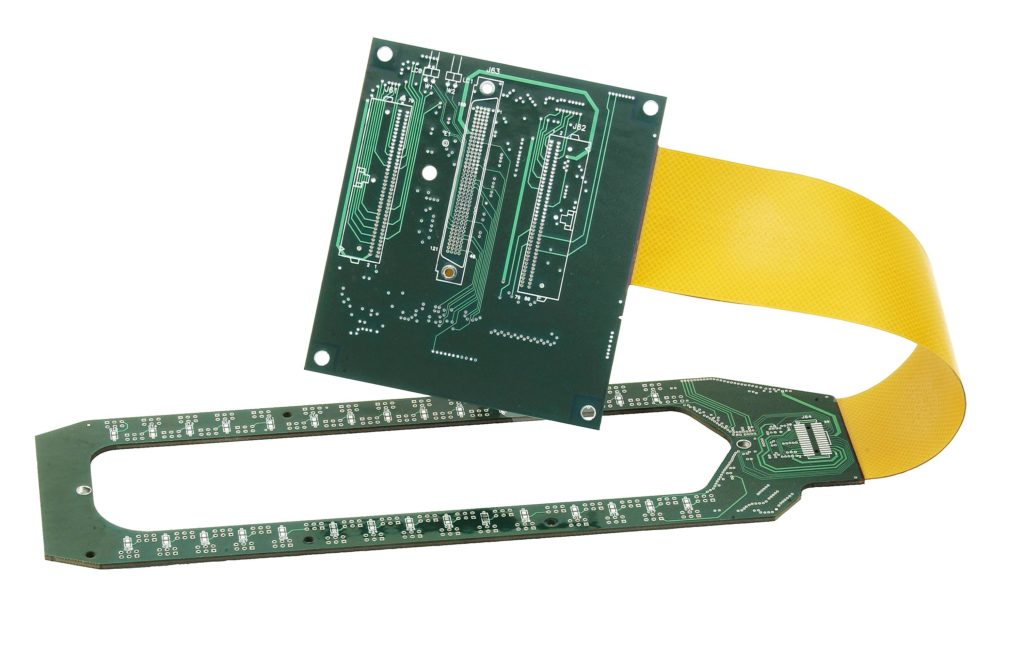
Rigid-flex PCB is a circuit board that combines flexible and rigid circuit board technology. Most rigid-flex PCBs are composed of multilayer flexible circuit boards that are attached to one or more rigid boards from the outside or the inside, depending on the design of the application. The flexible substrate is designed to be in a constant deflection state, and is usually formed as a deflection curve during manufacturing or installation.
Rigid-flex PCB manufacturing applications
Rigid flexible PCB provides a wide range of applications from smart devices to mobile phones and digital cameras. Rigid-flex PCB manufacturing has been increasingly used in medical devices such as pacemakers to reduce their space and weight. The use of rigid flex PCB has the same advantages and can be applied to intelligent control systems.
In consumer products, the rigid-flex PCB not only maximizes space usage and minimizes weight, but also greatly improves reliability, thereby eliminating many needs for solder joints and fragile and fragile wiring that are prone to connection problems. These are just a few examples, but rigid-flex PCBs can benefit almost all advanced electrical applications, including test equipment, tools, and automobiles.
Rigid-Flex PCB vs. Rigid and Flex PCB
As its name suggests, the rigid-flex PCB is a hybrid of both rigid and flex PCBs, and features the great qualities of both while eliminating many of their individual limitations. A rigid-flex PCB incorporates flexible materials in conjunction with rigid materials by layering flexible circuit substrates inside of the rigid circuit board materials, ultimately combining the versatility of flexible circuits with the stability, strength and circuit routing densities of rigid PCBs. This hybridization opens up a spectrum of possibilities for much more complex and mechanically challenging designs.
Rigid-flex PCBs are a means to streamline the electronic design, by eliminating flexible cables, connectors and discrete wiring. The electrical performance of a rigid flex PCB is enhanced compared to its counterparts, because the circuits are integral to the overall construction. All of the electrical and mechanical connections are internally contained within the rigid-flex PCB, providing the electronics designer with much improved service reliability and electrical performance.
While they do typically arrive at a higher cost than their flex and rigid board counterparts, the reliability, weight reduction, strength and space-saving advantages of rigid-flex boards are often ideal in certain applications, and outperform any other electronic packaging techniques. Ultimately, rigid-flex PCBs provide the best benefits of rigid and flex PCBs in one solution. Applications where rigid flex PCBs excel are:
- High-reliability applications. If an assembly will be exposed to excessive or repeated shock, or high vibration environments, connectors with flexible cables are more likely to fail. Rigid flex PCBs provide great reliability even when subjected to extreme vibration and shock applications.
- High-density applications. Within a small enclosure, it’s sometimes impossible to accommodate all of the cables and connectors that an electronic PCB design would require. Rigid flex boards can fold into very small, and very thin profiles, offering substantial space savings in these instances.
- Five or more rigid boards. If your application will ultimately involve five or more rigid boards connected to one another with flex cables, an integrated rigid flex solution is often the optimal and most cost-effective choice.
 Angle position sensor carbon printing pcb carbon circuit board batch PCB printed circuit board
 Single-sided quartz glass substrate Alumina Ceramic PCBs Biomedical testing 3D printer insulation bed, ceramic substrate luminous keyboard motherboard, alumina pcb grating gear
 High frequency and high speed circuit substrate ceramic pcb Characteristic impedance 50Ω ceramic printed circuit board differential impedance 100Ω ceramic substrate pcb circuit board
 1.0mm Ceramic Circuit Board ENIG alumina circuit board High frequency and high speed printed circuit board ceramic pcb board